Nautitech, Sea.AI GmbH Adding Machine Vision Safety Features to Seafaring Sailboats
Key Highlights
- The system uses thermal and low-light cameras to detect objects in the water.
- AI algorithms analyze captured data to identify and locate potential hazards and generate warnings for human crew,
- Future enhancements may include integration of additional sensors such as AIS and radar to increase situational awareness and move toward greater vessel autonomy.
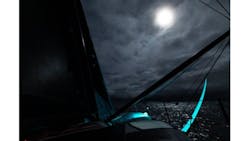
System uses thermal imaging, low light cameras, AI to detect potential hazards in waters
Nautitech Catamarans (Rochefort, France), a company that designs and manufactures sea-going luxury catamaran boats, has recently added AI-powered vision guided object detection systems to their boats. These systems, developed by Sea.AI GmbH (Linz, Austria), utilize thermal and high-resolution cameras and computers loaded with AI-powered software to help sailors detect and avoid potential hazards in the waters through which they are traveling.
This is not just a luxury; Rule 5 of the International Maritime Organization (London, England, UK) Collision Regulations requires that “every vessel shall at all times maintain a proper look-out by sight and hearing as well as by all available means appropriate in the prevailing circumstances and conditions so as to make a full appraisal of the situation and of the risk of collision,” notes Cedric Beaumont, Premium Service Manager, Nautitech Catamarans.
“When sailing short-handed, this very soon finds limitations as the crew needs to rest as well, and even when you are having a watch system on board, sooner or later there comes a time when no one is looking,” Beaumont says.
Seagoing boats often encounter any number of potential hazards at sea, from smaller watercraft that are not equipped with AIS (Automatic Identification System), a communication system used by ships and boats to send and receive identifying signals to avoid collisions, to smaller floating objects such as fishing gear, containers, and buoys.
This is where Sea AI’s system comes in, Bruno Guerin, Sea AI sales manager, says. Acting as another set of “eyes”, the system is designed to augment, rather than replace, human operators as well as other existing onboard technologies such as radar and AIS Guerin explains.
Raphael Biancale, who founded Sea AI in 2018, launched the company after an event during which he and his father were navigating a boat on the Mediterranean Sea, at night, and decided that the vessel did not have sufficient navigational safety systems in place.
“There was no moon, just total blackness, and he (Biancale) was very concerned because he couldn't see where he was going. He said that with all the technology that exists today, it should be possible to have something to provide some kind of safety system for sailors. He had been in the automotive industry, working on automated driving systems, so he decided to make a transfer from what existed in the automotive market to the maritime environment."
Components of the AI-powered maritime object detection system
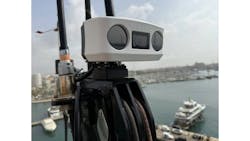
Today, Sea AI designs and manufactures several versions of the system for a variety of clients and different types of boats, from search and rescue and commercial vessels to racing sailboats and luxury pleasure boats. The Watchkeeper system, designed for sailing vessels such as Nautitech catamarans, utilizes two thermal cameras and one low light camera, and an onboard computer loaded with the AI software developed, designed and written by Sea AI. The computer and cameras can also be integrated into existing devices on board, Guerim says.
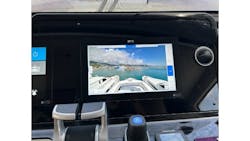
“We do not provide additional Multi-Function Displays(MFDs)with the system, so our interface is displayed on devices on board the boat, such as tablets, smartphones and existing MFDs or chart plotters,” Guerin says.
Related: Boulder Imaging Develops System to Protect Endangered Birds
Technical challenges in developing a maritime vision system
Guerin points out that much of the technology and information utilized in terrestrial based systems, such as autonomous cars, is not particularly usable in a maritime situation.
“On the sea, everything is moving,” Guerin says. “The boat is moving in 3D. You have waves, you have forms, you have many events coming up. So, it's not possible to make relevant detections using conventional AI from terrestrial applications.
Biancale decided to develop his own database to train the AI algorithms, Guerin says.
“As of now, we have over 10 million annotated maritime objects to train the AI,” Guerin says. “So. the detection is good in terms of locating objects, but we are still working on classifications.”
What this means is that the system is not autonomous, because it requires human interpretation to execute a decision, he says.
“The system provides alerts so the skipper will be able to see if it is something relevant to avoid or not,” Guerin says. “It may provide an alert for an object in the water that may turn out to not be relevant – seagulls, for example – something that does not necessarily require an action be taken.”
He also notes camera optics are similar to human eyes; if you have something between you and an object, you simply won’t see it.
“So, for example, if you have big waves, you will see objects when you are on top of the wave, but when you drop into the trough, you won’t. And a wave can block thermal cameras as well as low light cameras.”
To solve this, the system is mounted on top of the mast, so it can actually see behind waves, he says.
Future steps with the vision system
While the system is not fully autonomous, it has been successful for what it does, Guerin says.
“The next step will be to gather and integrate all the sensors to provide as clear an understanding of the surroundings as possible and possibly increase autonomy. So, it could be adding AIS, radar, and our system,” Guerin says.
About the Author

Jim Tatum
Senior Editor
VSD Senior Editor Jim Tatum has more than 25 years experience in print and digital journalism, covering business/industry/economic development issues, regional and local government/regulatory issues, and more. In 2019, he transitioned from newspapers to business media full time, joining VSD in 2023.